


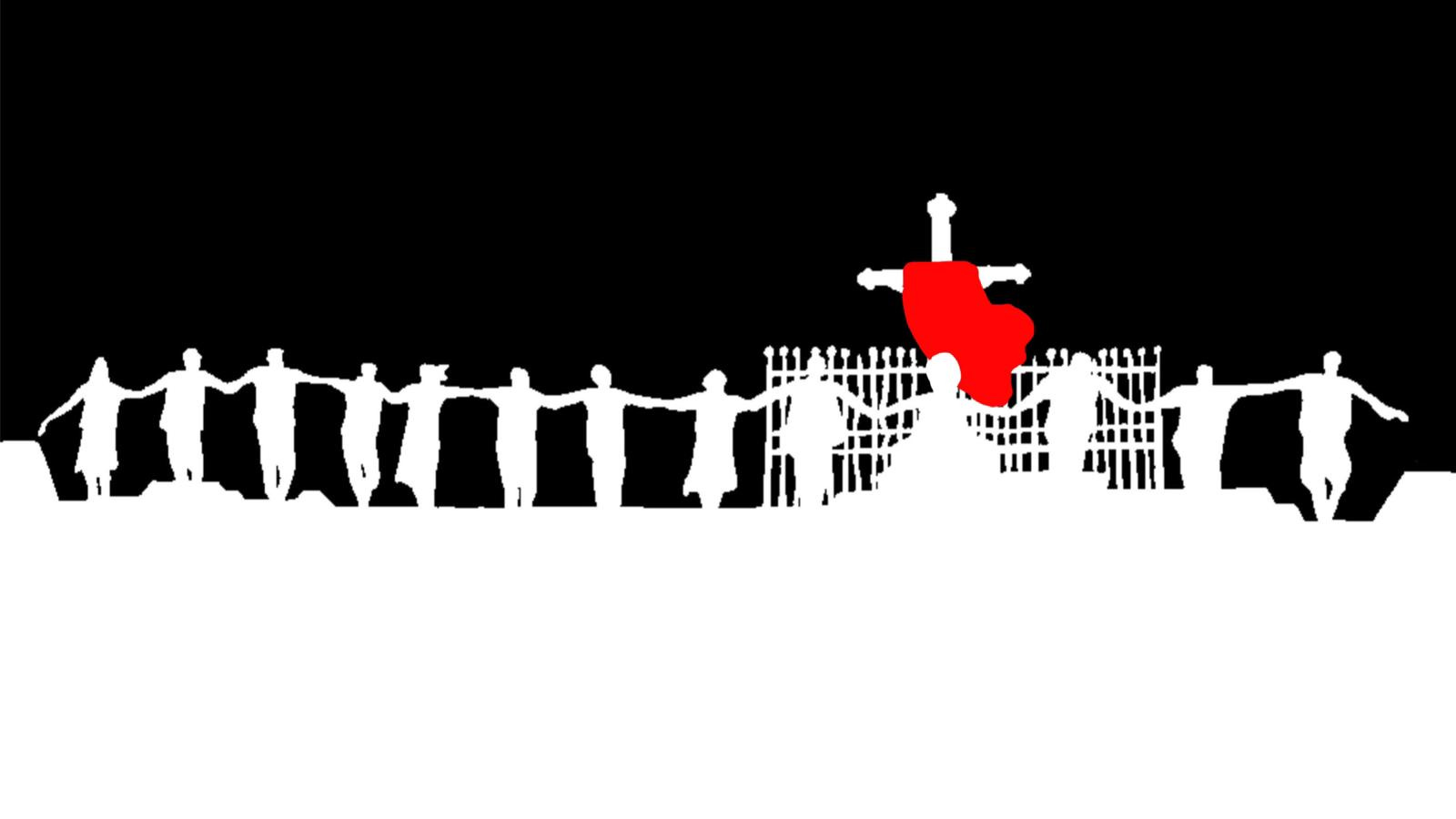
When The Confrontation was first premiered in Hungary, it was presented as a tribute film to the NÉKOSZ, a college-system estabilished between 1946-1949 with the purpose of educating the postwar youth into the socialist ideology. Jancsó himself belongs to this generation, but the film could not be further from a mere homage, or even a faithful historical representation. The confrontation between a unit of NÉKOSZ students who “invade” a catholic college in a monastery to challenge its students with a debate is, as often is the case for the filmmaker when tackling historical periods, a pretext, a backdrop for something more.
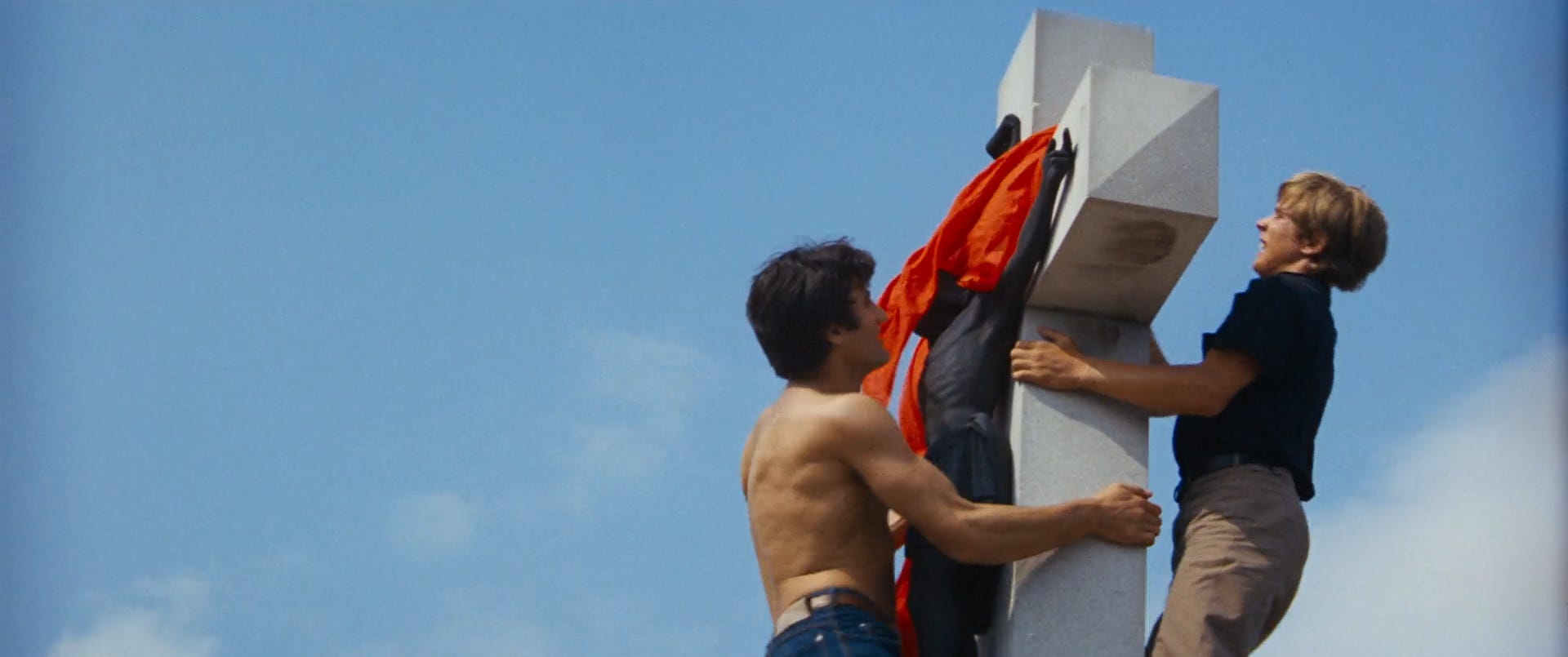
The storyline itself, which takes place throughout a couple of hours at most, sees the NÉKOSZ growing in its provocative coreography to elicit a reaction from the apathic catholic students to the point that they destitute their own leader, and when a more “militant” one is chosen, the group’s modalities become violent. The socialist students start to collaborate with the state police, that in the meantime occasionally shows up to monitor the situation or to intervene, the catholic students are forced to obey orders (often, as customary in Jancsó, they are ordered to move in the space of the courtyard), to the point that higher authorities are forced to intervene and stop the students.
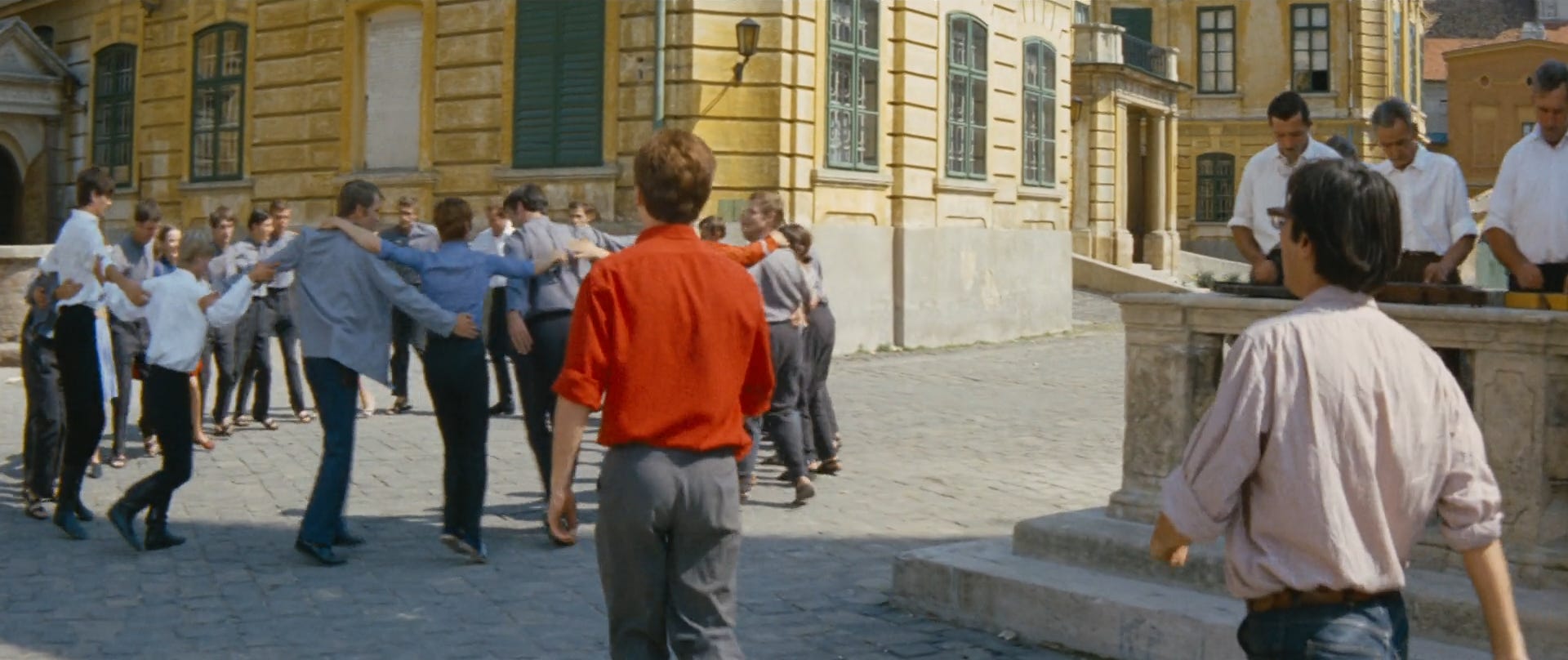
It is clear that The Confrontation is a parable of sorts, that there is more to it than a debate between ideologies — in fact, no debate ever takes place, in the end. Rather, the film dissects the way socialism ideology gets corrupted and degenerated by its constituents to the point that it sparks a totalitarism. What is very apparent is that the NÉKOSZ students have only been fed the slogans and ideas of communism and socialism, but, as the state police agent points out, they have never actually fought for the revolutionary cause, as he himself did just a few years before. The performance of the students is all the repertoire of communist chants, from “Bandiera Rossa” to “Sej, mi a lobogonak”, the song that contains the line “fényes szelek, fújjatok” (tr.: “sparkling winds, blow”) which provides the original hungarian title of the film, but the only concrete actions are violent against people who are not willing to be indoctrinated, in no way an act of uprising against capitalism. Moreover, the conclusion suggests clearly that Jutka, the girl under whose lead the NÉKOSZ group starts to behave violently and that is banned from the group by state authorities at the end of the film, still has a chance at a brilliant career in the actual socialist government of the country, precisely due to her leadership.
The underlying message of The Confrontation is therefore a deep-cut criticism towards the Soviet system, which, by 1969, has derailed greatly from the core values of the communist revolution or of marxism to become a generic totalitarism that echoes slogans and propaganda mindlessly. Jancsó, who grew up as a convinced marxist-bakuninist and remained faithful to his ideals throughout his life, would see in the system, after the Soviet repression of the 1956 uprising (which had the purpose of instaurating a socialist authority separate from the USSR hegemony), the Stalinist purges that by 1969 where publicly known, a degeneration of the values it claimed to profess. That is The Confrontation, a film that, amidst an increasingly performative form of political activism, is relevant still today.
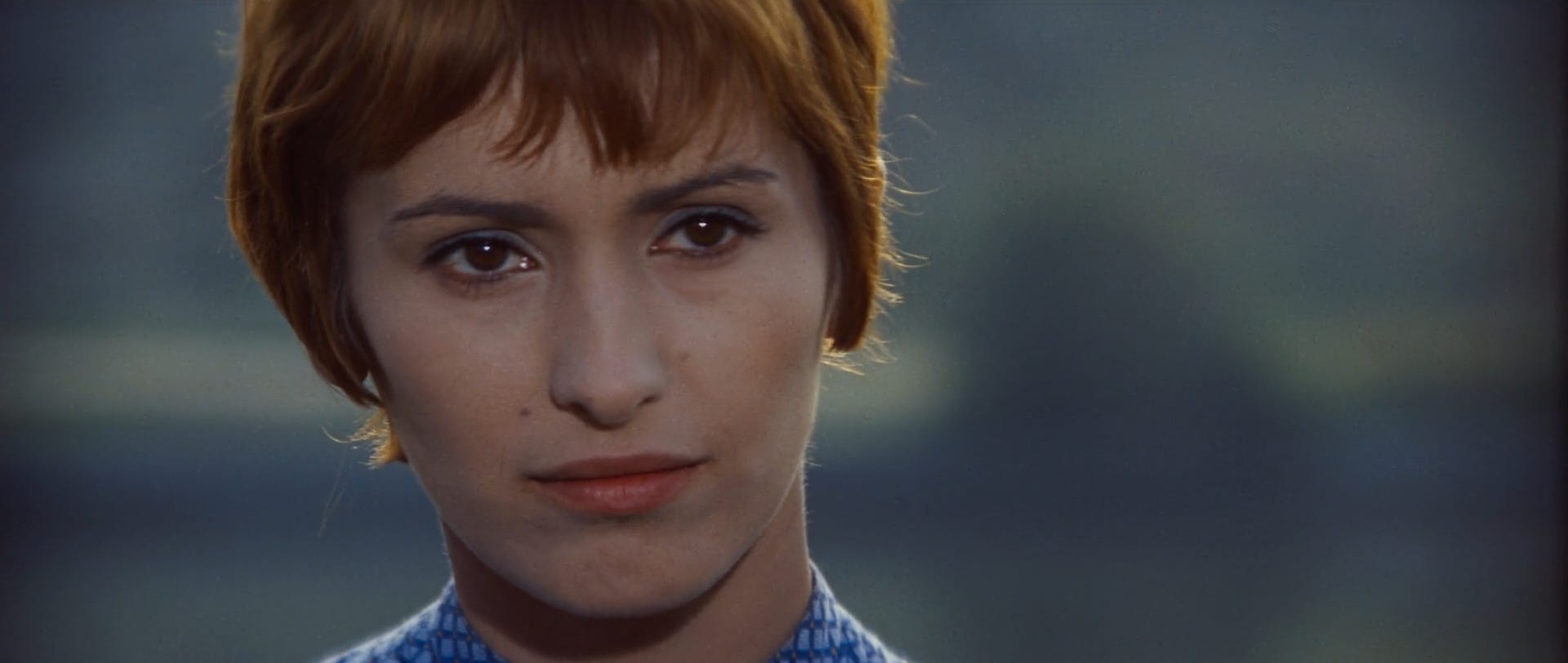
Except for a single cut to a close-up, the film is entirely structured in long takes, even more than any of the previous films — but the landscape, the hungarian plains, is traded for the closed courtyard of a monastery. If Silence and Cry constituted a great divide in Jancsó’s filmography, The Confrontation is a new starting point, and not only because it is Jancsó’s first colour film. Throughout 82 minutes, the movement never stops, be it the camera that follows characters constantly walking or running, or elaborate dances and coreographies that turn the film almost into a musical-ballet. This is the first of Jancsó’s films that truly expresses explicitly his love for theater direction, which he intended to take on before being convinced to study filmmaking. The gestual-symbolical and fluid movement of The Confrontation will only go further in its scope in films like Agnus Dei or Red Psalm.
The Confrontation is Jancsó’s first taste into a form of filmmaking that is entirely metaphorical and theatrical in its conception, but also a fundamental film on the risks of the performativity of political activism when they detach too much from actual action.
RATING: 4/5
-
Original Title: Fényes Szelek
Directed by: Miklós Jancsó
Country: Hungary
Year: 1969
Runtime: 82 min.
Availability: filmio, Second Run, Kino Lorber